
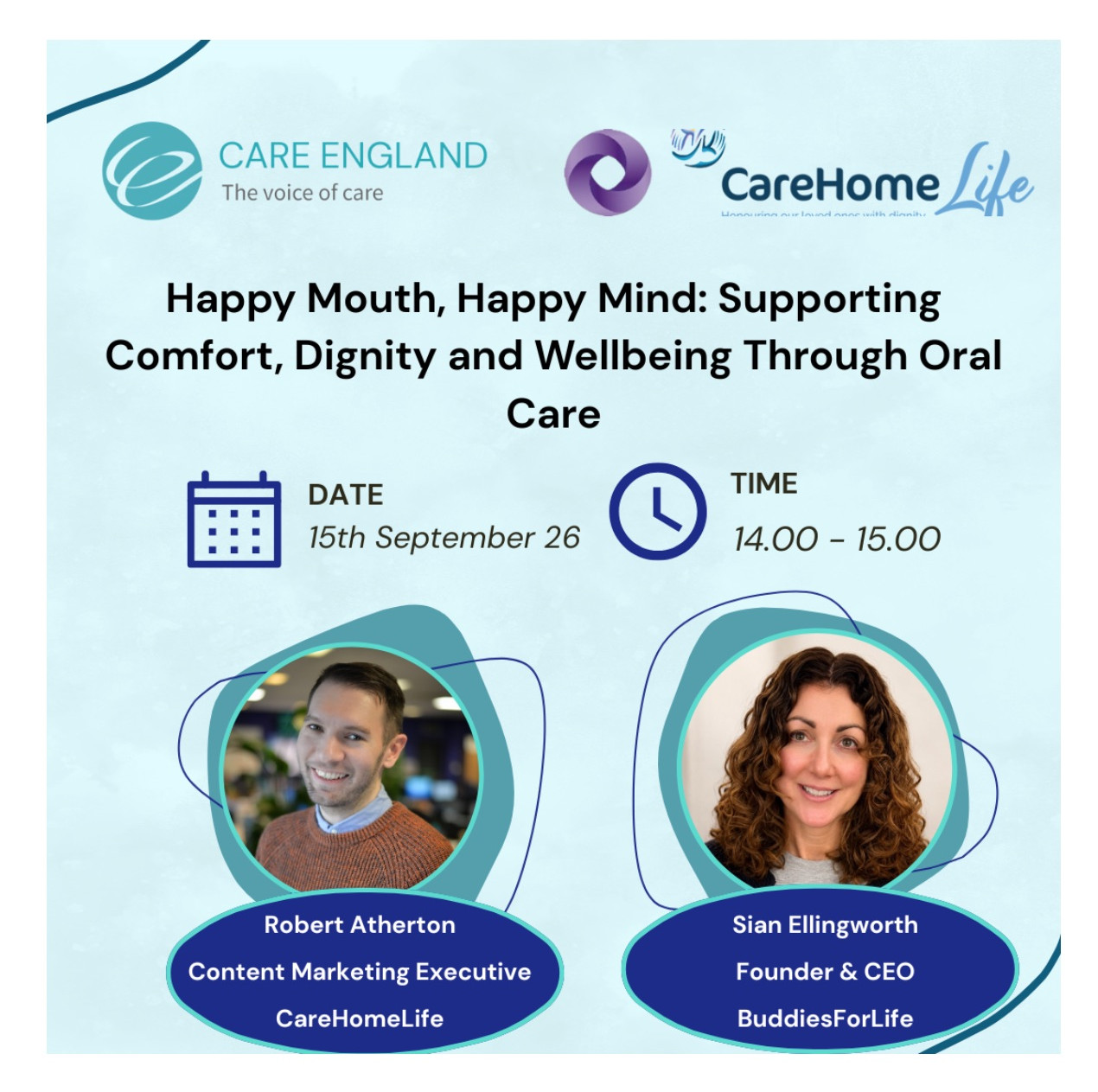
Webinar - 15th September - 2pm: Happy Mouth, Happy Mind: Supporting Comfort, Dignity and Wellbeing Through Oral Care
When Oral Care becomes difficult: Why it isn't always about refusal.
Oral care is one of those everyday tasks that can look simple from the outside.
Brush twice a day. Use fluoride toothpaste. Clean dentures. Keep an eye out for changes.
However, anyone working in residential care knows that the reality can be much more complicated.
A resident may turn their head away, clamp their mouth shut or become anxious when a toothbrush appears. They may stop doing something they previously managed independently or repeatedly decline support from care staff.
It is easy for this to become described as "refusal". What if the more useful question is: what is making oral care difficult for this person?
Look beyond the behaviour
For somebody living with dementia, the sequence involved in brushing may no longer make sense. They may not recognise the toothbrush, understand what a carer is asking them to do or remember why somebody is approaching their mouth.
For another resident, the problem might be physical. Reduced dexterity can make holding or manoeuvring a toothbrush difficult. A tender mouth can make brushing uncomfortable.
There are sensory factors too.
Toothpaste has a strong taste, smell and texture and can foam too much. A toothbrush can feel scratchy or intrusive. For somebody who experiences these sensations more intensely, or whose tolerance changes through illness or cognitive decline, something that appears routine to somebody else can become genuinely unpleasant.
This matters because oral care is about considerably more than clean teeth.
NICE highlights the importance of oral health to dignity, self-esteem and quality of life, as well as eating, speaking and socialising. It also advises care teams to understand the potential impact of untreated dental pain or mouth infection on the behaviour and wellbeing of residents who may struggle to communicate their discomfort.
The care sector has made progress
When the Care Quality Commission revisited oral health in care homes in 2023, it found considerable improvement since its original Smiling Matters review in 2019.
Awareness of NICE oral health guidance among care homes had increased from 61% to 91%. The proportion of care plans fully covering residents' oral health needs had also more than doubled, from 27% in 2019 to 60% in 2022.
That progress is important.The next challenge is making sure good oral care policy translates into an approach that works for each individual resident.
Sometimes small changes matter
There may not be one universal solution. For one person, maintaining a familiar routine may help. For another, it may be changing the time of day for their oral care.
Someone may be more comfortable doing as much of their own brushing as possible, with prompting rather than intervention.
Others may benefit from reconsidering the toothbrush being used, the flavour or texture of toothpaste, the environment in which brushing takes place, how instructions are given, or whether oral discomfort could be contributing to the problem.
The starting point is curiosity rather than confrontation. Instead of asking only, "How do we get this resident to brush?", care teams can also ask: "What could be making brushing difficult, and what can we change?"
That is one of the questions Sian Ellingworth, Founder and CEO of BuddiesForLife, and Robert Atherton of CareHomeLife will explore in Care England's upcoming webinar, Happy Mouth, Happy Mind: Supporting Comfort, Dignity and Wellbeing Through Oral Care.
The session will look at the everyday oral-care challenges experienced in care settings and practical ways teams can support residents while protecting comfort, independence and dignity.
Happy Mouth, Happy Mind: Supporting Comfort, Dignity and Wellbeing Through Oral Care - Webinar: 15th September, 2pm


Comments